
From Copilot to Swarm: Why 2026 is the Year of the "Digital Assembly Line"
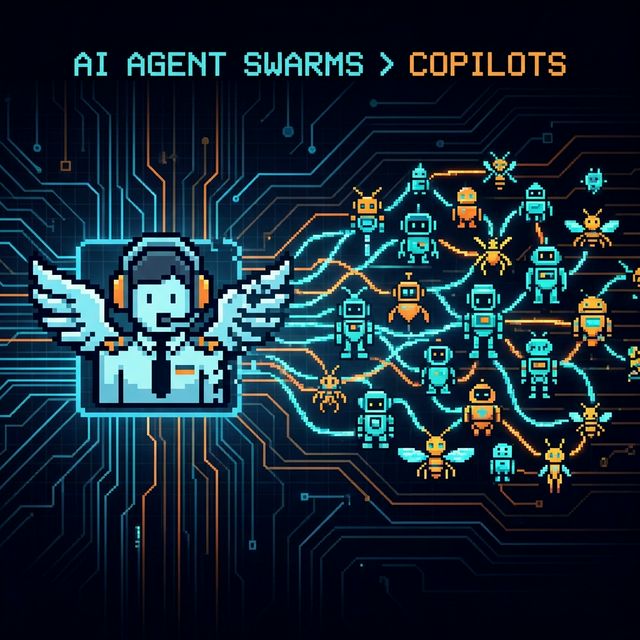
The "Copilot" Era is Over. Welcome to the Swarm.
We have spent the last two years treating AI as a Copilot—a glorified autocomplete that sits in your IDE and waits for you to type. It was helpful, sure. It saved us keystrokes.
But in 2026, "saving keystrokes" is the wrong metric.
The industry is shifting rapidly toward Agentic Swarms: autonomous, multi-agent systems where specialized AI agents collaborate to ship features, not just write functions.
The Core Shift:
- 2024 (Copilot): Human prompts AI -> AI generates code -> Human pastes/reviews.
- 2026 (Swarm): Human defines Goal -> Orchestrator plans -> Specialist Agents execute (Code, Test, Deploy) -> Human approves.
- The Impact: Research predicts AI will manage 70-80% of routine code generation by late 2026, shifting the human role almost entirely to high-level architecture and review.
1. What is an Autonomous Coding Swarm?
Direct Answer: An Autonomous Coding Swarm is a multi-agent system where distinct AI agents with specialized roles (frontend, backend, QA) collaborate to complete complex software engineering tasks without continuous human intervention. Unlike Copilots, they share a persistent context and can self-correct.
Think of it as a "Digital Assembly Line." You don't ask ChatGPT to "write a snake game." You ask your Product Manager Agent to spec it out. It then hands tasks to the Developer Agent, who passes code to the QA Agent.
If the QA Agent finds a bug, it sends it back to the Developer Agent. You don't even see the error message. You just see the green checkmark at the end.
2. The Architecture of a 2026 Swarm
The "Magic" isn't in the LLM anymore (GPT-6 vs. Claude 5 matters less than you think). The magic is in the Orchestration Architecture.
The Three Pillars:
- The Orchestrator (The Brain): A high-level agent that breaks down PRDs into tickets and assigns them. In Salesforce Agentforce, this is the "Atlas" reasoning engine.
- The Context Layer (MCP): The Model Context Protocol (MCP) has won the standards war. It allows your Swarm to securely access your GitHub, Jira, and Salesforce orgs without hallucinogenic "context collapse."
- The Worker Bees: specialized, fine-tuned agents.
- The "Apex Specialist" (trained on your org's patterns).
- The "LWC Builder" (knows your design system).
- The "Red Teamer" (tries to break the code before you see it).
3. Salesforce Agentforce: The Enterprise Swarm
For those of us in the Salesforce ecosystem, this isn't sci-fi. It's the roadmap.
Agentforce is essentially a "Swarm-in-a-Box" for the enterprise. It allows you to deploy low-code agents that don't just chat with customers but actually perform work in the CRM.
But the real power for developers is Agentforce for Developers. Imagine an agent that monitors your Sandboxes, detects Apex CPU timeouts, and automatically drafts a refactoring PR to bulkify the code. That is not a tool; that is a teammate.
4. How to Survive the Shift (From Coder to Architect)
Does this replace us? No. But it promotes us (whether we like it or not).
In a Swarm economy, the value of "typing syntax" drops to near zero. The value of System Architecture, Review, and Governance skyrockets.
Your New Job Description:
- Define the Spec: If you give a Swarm a vague requirement, you get "Workslop" (working but useless code). You must master Spec-Driven Development (SDD).
- Audit the Output: You are no longer writing code; you are doing Code Reviews for 10 junior developers (the agents) who work at lightspeed.
- Manage the Context: Curating the documentation and examples that feed the Swarm's knowledge.
Conclusion: Don't Wait for the Future
The tools are already here. Whether you are using open-source frameworks like LangGraph or CrewAI, or enterprise platforms like Agentforce, the era of the "Lone Wolf Developer" matches are numbered.
Start building your swarm today. Or be prepared to be outpaced by someone who has one.