
Stop Vibe Coding: The Spec-Driven Stack for 2026
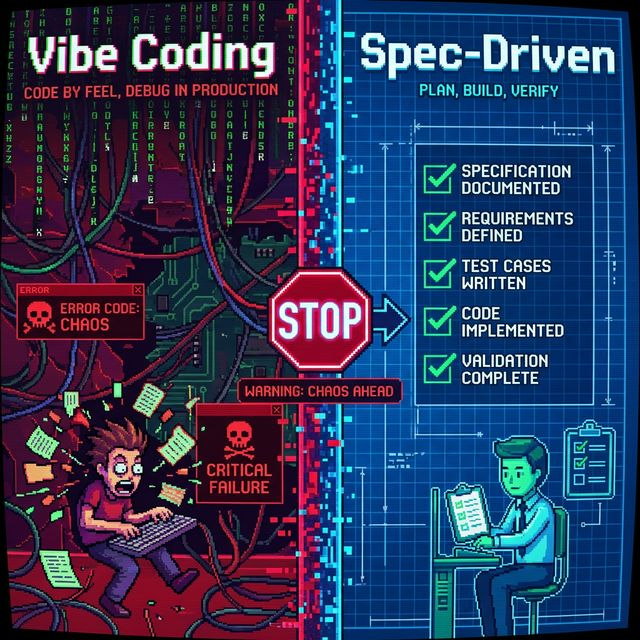
The "Vibe Coding" Trap
Direct Answer: SDD (Spec-Driven Development) is the practice of maintaining a "Living Specification" (Markdown/Mermaid) that serves as the single source of truth for AI agents, replacing ephemeral chat context. It ensures that agents remain aligned with architectural constraints and business logic as they iterate.
You've been there. You type "Fix the bug" or "Add the button," and for the first 10 minutes, it's magic. Then, slowly, the magic turns into "Workslop." The agent starts rewriting files unnecessarily, hallucinating APIs that don't exist, and eventually breaks the very thing it fixed five prompts ago.
This is the "Context Collapse" trap. You're "Vibe Coding"—relying on the agent's current memory and your own intuition. It works for scripts; it fails for systems. To build production-grade agentic workflows in 2026, you need a Spec.
The "Agentic Stack" 2026
Direct Answer: The modern agentic stack consists of three layers: Your Agentic IDE (Windsurf, Cursor, VS Code, or OpenAI Codex) for execution, a Context Protocol or Skill Set (MCP/Antigravity) for data connectivity, and a Structured Spec (Markdown/Rules) as the persistent source of truth.
In the Agentic Era, the IDE needs to be more than a text editor; it needs to be an orchestrated environment where you are the Architect.
1. The Architect (Choosing Your Environment)
Direct Answer: The choice of environment has matured. Windsurf (Cascade) and Cursor (Agent Mode) remain leaders in deep context, while VS Code with GitHub Copilot has evolved into a full agentic powerhouse with native planning and multi-file editing features. The massive arrival of the OpenAI Codex App has shifted the focus toward a "Command Center" that orchestrates multiple specialist agents in parallel.
For those who want to supercharge any of these environments, the Antigravity Kit has emerged as the essential "OS layer," providing pre-built skills and specialist templates that make any agent behave like a Senior Engineer.
- Windsurf: Best for autonomous "thinking" during complex refactorings.
- Cursor: Best for surgical precision and power-user control.
- VS Code + Copilot: Best for seamless ecosystem integration (GitHub/Azure). Now a full-blown agentic ecosystem with Agent HQ and native orchestration.
- OpenAI Codex: The ultimate "Agent Orchestrator" for parallel workflows.
- Antigravity Kit: The "Protocol-Agnostic" kit that levels up every agent with tailored skills.
2. The Blueprint (Writing the Spec)
Direct Answer: A "Living Spec" is a structured document (typically .md) that defines the project's requirements, implementation plan, and technical constraints. It acts as the agent's "long-term memory," preventing it from drifting into hallucinations during long development sessions.
Stop writing 50-page PDFs. Start writing "Unit Specs."
- PRD.md: The "What" and "Why."
- IMPLEMENTATION_PLAN.md: The "How."
- TASKS.md: The "Checklist."
When the agent finishes a task, it updates the TASKS.md. When you change your mind about the architecture, you update the PLAN.md. The agent reads these every time.
3. The Protocol vs. Skills Debate
Direct Answer: While the Model Context Protocol (MCP) provides the universal connectivity to external tools (SQL, Jira, APIs), a new trend is emerging: Agentic Skills. Projects like Antigravity Kit use local "Skills" (structured instruction sets + CLIs) to guide agents to perform complex tasks without the token-overhead or latency of a dedicated MCP server.
MCP is the "USB-C" of data, but Skills are the "Training Manuals." In 2026, the most efficient teams are using MCP for read operations (live data) and Skills for write/orchestration operations (executing CLI commands, deploying, and validating).
Workflow: From Idea to PR
Direct Answer: The Agentic SDD workflow follows four distinct steps: 1) Brainstorming (Chat), 2) Crystallization (Writing the Spec), 3) Execution (Agent coding against the Spec), and 4) Verification (Automated testing and manual review against the original requirements).
- Brainstorm: Talk to Your Agentic IDE. "How should we build this?"
- Crystallize: Save the result to
docs/SPEC.md. This is the most important step. - Execute: "Read the SPEC.md and implement Phase 1."
- Verify: The agent runs the tests. If they pass, you review.
Conclusion: Lead or Be Outpaced
The "Lone Wolf" developer who types every character is being replaced by the "Agentic Architect" who designs the specs.
Start building your .agent/ folder today. Or get used to the Workslop.